Kurukshetra
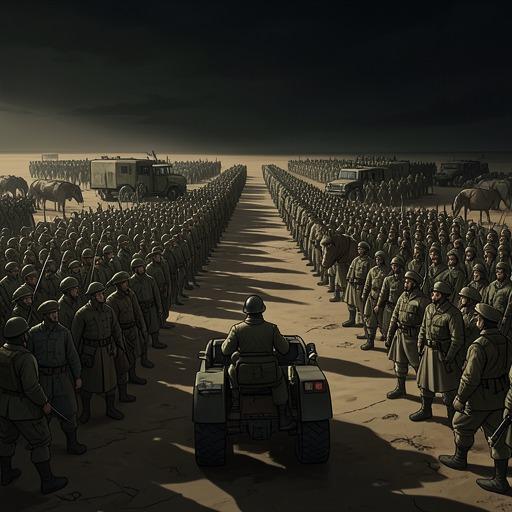
Bhagavad GitaKurukshetra is the sacred plain on which the Pandavas and Kauravas confront one another in the decisive crisis of the narrative. It is at once a battlefield, a ritualized space of judgment, and the setting for the Krishna–Arjuna Dialogue. The armies arrive seeking combat, yet the field’s most consequential action begins before the fighting: Arjuna looks upon his relatives, lays down his weapons, and forces the meaning of duty and violence into the open.
Sacred Plain and Assembly of the Armies
Kurukshetra is introduced through Dhritarashtra’s anxious question to Sanjaya about what his sons and the Pandavas did after assembling on the sacred plain with the desire to fight. Its sanctity stands in sharp contrast to the immediate purpose of the gathering. A place marked as sacred becomes the ground of dynastic warfare, joining religious significance to political and familial conflict rather than separating them.
The field is first rendered through military arrangement. Duryodhana surveys the Pandava army and names its principal warriors, including Bhima, Arjuna, Drupada, Dhrishtadyumna, Virata, and the sons of Draupadi. He then identifies the leading fighters on the Kaurava side, among them Drona, Bhishma, Karna, Kripa, Ashwatthaman, Vikarna, and Jayadratha. His assessment reveals both the scale of the confrontation and his dependence on Bhishma’s protection. The battlefield is therefore also a field of comparison and apprehension, where the strength of each force is measured before the first exchange.
The armies’ presence is made audible through the opening of war. Bhishma gives a lion-like roar and blows his conch; drums, cymbals, horns, and other instruments answer him. Krishna and Arjuna, standing together on a great chariot yoked to white steeds, sound Panchajanya and Devadatta, while Bhima, Yudhishthira, Nakula, Sahadeva, and the other leading warriors blow their own conches. The reverberation through earth and sky terrifies the Kaurava troops, turning the field into a resonant public declaration of allegiance and impending violence.
Arjuna’s Chariot Between the Armies
At the moment missiles are about to be cast, Arjuna asks Krishna to place his chariot between the two armies. His stated purpose is observation: he wants to see those assembled to fight and to identify the men supporting Duryodhana. The request creates the central vantage point of the opening scene. Instead of remaining within the momentum of battle, Arjuna is brought into a position from which both sides can be seen together.
Krishna places the chariot before Bhishma, Drona, and the assembled kings. From that position Arjuna recognizes not an abstract enemy but a network of kinship: fathers and grandfathers, teachers, sons, grandsons, friends, fathers-in-law, maternal uncles, brothers-in-law, and well-wishers stand in both armies. The battlefield’s military geometry is thus transformed into a family tableau. The same arrangement that makes combat possible also makes its human cost visible.
Arjuna’s physical response marks the field as a site of moral crisis. His limbs grow weak, his mouth dries, his body trembles, his hair stands on end, his skin burns, and Gandiva slips from his hand. He cannot stand steadily, and his mind wanders. The weapons and formations that previously signified readiness now become signs of a catastrophe he cannot accept. Kurukshetra exposes the conflict between the warrior’s public duty and the intimate obligations of kinship.
The Field as a Crisis of Duty
Arjuna declares that he does not desire victory, sovereignty, pleasure, or even life if those for whose sake such things are wanted are present on the field ready to die. He refuses to see political success as compensation for the destruction of teachers, elders, sons, and relatives. Even if the opposing side is regarded as hostile, he argues that killing them will bring sin, and he asks how happiness could arise from the slaughter of one’s own family.
His reasoning expands from personal grief into a theory of social collapse. The destruction of a race, he argues, extinguishes its eternal customs; when those customs disappear, sin overwhelms the community. He fears the corruption of women, the intermingling of castes, the abandonment of family rites, the fall of ancestors when offerings of food and water cease, and the eventual condemnation of both the destroyers and the destroyed race to Hell. Kurukshetra is therefore imagined not merely as a place where individuals die, but as the point at which lineage, ritual continuity, and social order may be broken.
Arjuna finally judges the intended battle to be a great sin undertaken for the sweetness of sovereignty. He would rather be killed unarmed and unresisting by the sons of Dhritarashtra than raise his weapons against them. Having spoken in this way on the field, troubled by grief, he casts aside his bow and arrows and sits down on his chariot. The battlefield’s first decisive reversal is consequently an act of refusal: the warrior prepared to fight becomes the man who cannot act.
From Battlefield to Teaching Space
Although Kurukshetra remains the place of war, Krishna’s response turns it into a setting for philosophical instruction. Arjuna’s refusal prompts questions about the relation between devotion and work, renunciation and action, knowledge and duty. Krishna teaches that no one can remain without action, that action performed without attachment is superior to mere abandonment of work, and that work undertaken as sacrifice can free a person from its binding consequences.
The field also receives a larger temporal and cosmic meaning. Krishna explains that the imperishable teaching was transmitted from Vivasvat to Manu and from Manu to Ikshaku before being lost to the world and declared again to Arjuna. He describes divine birth as occurring whenever piety declines and impiety rises, so that the righteous may be protected, wrongdoers destroyed, and piety re-established. The immediate crisis on Kurukshetra is thereby connected to a recurring pattern of moral disorder and restoration.
The battlefield’s temporal scale is further enlarged by the account of Brahma’s day and night. During Brahma’s day, manifest beings arise from the unmanifest; during Brahma’s night, they disappear into it and later emerge again. The bright and dark paths after death lead respectively toward non-return or return, while attainment of the Supreme Being ends rebirth. Against these immense cycles, the battle becomes a concentrated moment in which a human decision participates in a cosmic order without ceasing to carry personal and social consequences.
The Battlefield’s Religious and Philosophical Significance
Kurukshetra’s sanctity is not exhausted by its status as a holy location. It is the place where abstract teachings acquire immediate pressure. Krishna’s instruction that a person should perform his own duty, even imperfectly, rather than another’s duty well performed, bears directly on Arjuna’s reluctance to fight. The field makes the question unavoidable: whether withdrawal from violence is genuine moral wisdom or an evasion of the duty arising from one’s nature and position.
The same setting supports a movement from ritual action toward inward knowledge and devotion. Krishna teaches that offerings, actions, food, gifts, and austerities can be dedicated to him; that even a person of exceedingly wicked conduct can become righteous through rightly directed devotion; and that people of sinful birth, women, Vaisyas, and Sudras can attain the supreme goal by resorting to him. The battlefield thus becomes a place where social distinctions are discussed alongside a claim about universal access to spiritual refuge.
Krishna also distinguishes the body as Kshetra, or field, from the knower of the field. The physical field of Kurukshetra consequently participates in a wider metaphorical structure: visible matter, action, change, and conflict belong to the realm that must be known, while true knowledge concerns the relation between the embodied field and the knower within it. At the end of the dialogue, Krishna tells Arjuna to abandon all duties and take him as his sole refuge, promising deliverance from sin. Arjuna then says that his delusion has been destroyed, his recollection restored, his doubts dispelled, and that he will do Krishna’s bidding.
Kurukshetra therefore stands at the intersection of history, ritual, family, and metaphysics. It begins as the sacred plain where armies gather and ends as the place where paralysis is converted into understanding and decision. The war remains the outward crisis, but the field’s enduring narrative importance lies in the transformation that occurs before combat resumes: Arjuna’s gaze turns battle into a question about the structure of duty, and Krishna’s answer turns that question into a path toward disciplined action and liberation.